I Installed Fedora and Accidentally Created a Haunted House
Installing Fedora - It Started Out Great
I decided to give Linux the daily driver test in 2026, so I set up dual boot with Fedora 43 KDE Plasma.
The installation seemed easy enough: shrink my Windows partition, flash the Fedora ISO to a thumb drive, install Fedora, and test. Fedora came up great first try, even supporting 5120x1440 resolution on first launch!
I was tinkering with the desktop widgets when I got a text from my fiancée who’d gone to bed already.
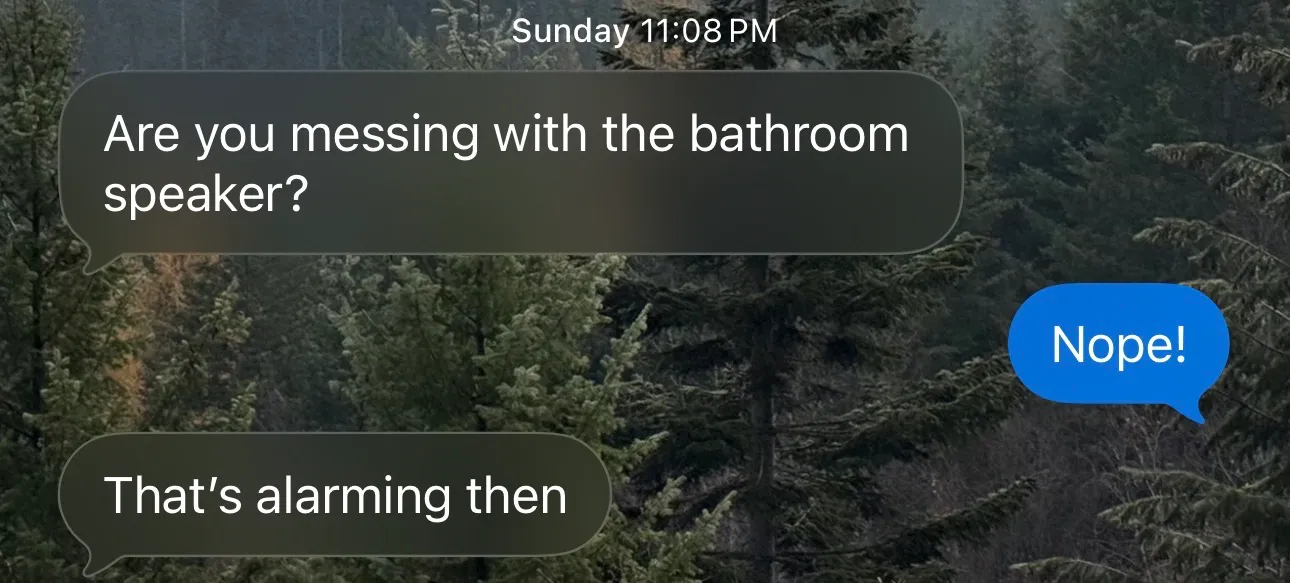
This was concerning to me, so I wrapped up my evening, shutdown my desktop, and went and unplugged the HomePod.
The Next Day
I booted into Fedora the next evening, and after setting up a mail client, I heard a few odd noises from the living room. I went to investigate.
Nothing.
Then, a notification sound came from the HomePod.
Fedora showed no audio devices initially, but after selecting an option to show all devices, my three HomePods popped up.
What? I was shocked, then impressed at the auto-discovery of HomePods on the network, then lightly concerned.
Why is Fedora defaulting to use HomePods as speakers?
I had a wireless headphone dongle plugged in, but it wasn’t showing up. Something was amiss.
Driver / Kernel Mismatch
It turns out Fedora wasn’t trying to prank me.
My system had drifted into a mismatch between the running kernel and its associated modules, likely caused by updating the kernel after installation.
This wasn’t a hard fix, but it was definitely an annoying one.
After updating the audio drivers, I saw my headset and monitor as audio devices, and I quickly made my headset the default device. For extra measure, I muted all three HomePods as well. I may remove them entirely, but I like the idea of having music through my office HomePod.
Fedora had successfully installed enough operating system to gaslight me, but not enough matching kernel modules to behave normally.
Closing Thoughts
Linux was pranking me, but only after I’d updated the kernel. Out of the box, things worked fine at first. Once everything lined up, Fedora has actually been rock solid. But it was a good reminder that Linux won’t always fail loudly. Sometimes it just misbehaves.
And if you ever hear phantom audio coming from your house after installing Fedora, don’t panic.
It’s probably not haunted.
You might just need to install the right kernel modules.
Thanks for reading, and remember: It’s always DNSauve ;)
← Back to blog